The Systematic Dispossession of Kashmiri Pandit Property

The Systematic Dispossession: Kashmiri Pandit Property Grabbing
Investigative Report

The Systematic Dispossession
of Kashmiri Pandit Property

How revenue fraud, institutional complicity, and the absence of displaced owners turned property theft into paper-legal “transfers” — documented through Crime Branch records, court orders, and satellite evidence.

Based on Crime Branch complaints (2012) • Court records • Satellite imagery • Legislative history
Section I

The Missing Data on a Known Crime

The 1990 exodus of Kashmiri Pandits is well-documented as a demographic catastrophe — over 100,000 families displaced from a homeland where they had lived for millennia. What is far less documented is what happened to the property they left behind. Researchers seeking data on KP property dispossession, distress sales, and land grabbing find an evidentiary vacuum: there is not much. The absence of systematic data is itself a form of erasure.

However, scattered across Crime Branch files, court records, and legislative archives lies a body of evidence that, when pieced together, reveals a comprehensive system of property dispossession — not ad hoc thefts by individual opportunists, but a pattern implicating revenue officials, land brokers, legal machinery, and administrative complicity at every level.

This report draws on one such data source — Crime Branch complaints received from Kashmir Province during the year 2012 — and supplements it with court records from a landmark property restoration case and satellite imagery, to reconstruct the methods, scale, and institutional architecture of Kashmiri Pandit property grabbing.

Section II

Crime Branch Complaints: Kashmir Province, 2012

The Crime Branch of Jammu & Kashmir Police received at least 20 property-related complaints from Kashmir Province in 2012 alone. Each complaint documents a specific instance of property crime — ranging from illegal occupation and encroachment to forged revenue records, fake powers of attorney, temple land theft, and fraud in the migrant relief system.

20
Complaints Filed
9
Illegal Occupation
5
Forged Documents
3
Temple Property
Crime Branch Complaint Register — Kashmir Province, 2012
Crime Branch complaints table 2012
Official Crime Branch register listing property-related complaints received from Kashmir Province during 2012. Source: J&K Crime Branch records.

The complaints can be classified into four distinct categories of property crime, each representing a different mechanism of dispossession:

Classification of Property Crimes by Type (2012 Complaints)

The Complaint Register: Case by Case

Clt. No. Complainant Crime Type Gist Disposal
294/2012Munoo Ji Dhar, ShopianEncroachmentIllegal, unauthorised possession of land measuring 4K shamilatRef to DIG SKR
158/2012Rakesh Koul, BandiporaEncroachmentIllegally occupied the migrant landRef to DC Bandipora
291/2012Bansi Lal Raina, KulgamEncroachmentEncroached residential house/land of the complainantRef to DC Kulgam
320/2012Chandera S. BhatnagarEncroachmentForcibly taken possession of land of the complainantRef to DC Srinagar
441/2012B.L. Pandita familyTemple PropertyConspiracy to sell land without consent, situated at Raghu Nath MandirRef to DC Srinagar
477/2012Payar Lal Bhat, SarwanandFraudRevenue officials fraudulently made entries, impersonating father of complainantRef to DC Ganderbal
503/2012Syed Altaf H. BukhariFraudLand broker cheated — produced forged documents during constructionRef to DIG CKR
570/2012Kuldeep Kumar DharFraudIllegal construction raised on land at New Bus Stand Handwara using illegal documentsInitiated PV
573/2012Yashpal Ram, UriEncroachmentRestoring possession of land taken by one Nazir Ahmad GujjarRef to DC Baramulla
581/2012Aruna Khajuri (woman)FraudExecuted fake power of attorney with regard to land in father’s nameInitiated PV
582/2012Migrant Pandith, ShopianFraudIllegally/fraudulently recorded land in his nameRef to DC Shopian
652/2012Shamboo Nath & Gopi NathEncroachmentEncroached over the land/Purni owned by the applicantsRef to DC Kupwara
653/2012Omkar Nath & BrotherEncroachmentIllegally taken possession/encroachment of landed propertyRef to DC Kupwara
508/2012Dist. Magistrate Srinagar via SSP CBKEncroachmentEncroachment and sale of Migrant property in RainawariRef to local police
892/2012Riyaz Ahmad BhatTemple PropertySold land of different Mandirs at various placesRef to Div Com (K)
433/2012Firdous Ahmad MalikRelief FraudReceiving ration by deceiving authorities, illegal migrant relief from JammuRef to Relief Comm
548/2012Bashir Ahmad ShahRelief FraudPM’s service quota fraud, double drawls in state control boardInitiated PV
671/2012Residents, Pounch GundRelief FraudAcquired huge amount by fraudulent registration as migrant at Relief CommissionerConsigned to records
698/2012Mohd Jamal Waza, KupwaraEncroachmentForcibly grabbed property of complainant by illegal meansRef to SSP Kupwara
427/2012Surinder Ganhar, Temple TrustTemple PropertyTrespassed into temple complex and cut 50 grown willow/poplar treesRef to DC Srinagar
Section III

Patterns of Dispossession

The 20 complaints, though a fraction of the actual incidence, reveal several structural patterns when examined together — patterns that point to a system, not a series of coincidences.

1. Rot From Root to Leaf

The complaints do not describe property crimes committed only by private individuals. Revenue officials are named as co-conspirators in multiple cases — fraudulently making entries in revenue records (case 477/2012), attesting fabricated mutations, and facilitating illegal constructions through forged documents (case 570/2012). The complicity extends from the patwari at the village level to the tehsildar and beyond. The Distress Sales Act has undergone multiple amendments — sometimes favouring the original owner, sometimes the buyer — reflecting the government’s own awareness that the administrative machinery was compromised, and its inability to devise a coherent response.

2. Targeting the Vulnerable

The complaint data reveals a pattern of predatory targeting. Women complainants — including non-KP Hindu women — appear in the records, their property grabbed through mechanisms like fake powers of attorney executed in their fathers’ names (case 581/2012). The perpetrators were not acting randomly; they were selecting victims who were least likely to fight back — women without male advocates, members of tiny minority populations, families displaced hundreds of kilometres away — and most likely to accept a token cash settlement out of helplessness.

Geographic Distribution of Complaints by District

3. Rainawari: If Here, Then Everywhere

Rainawari in Srinagar was one of the densest historical clusters of Kashmiri Pandit habitation in the Valley — a neighbourhood where KPs had lived for centuries and maintained strong community networks. Yet even here, the Crime Branch itself reported encroachment and sale of pandit properties (case 508/2012). If property crimes were this brazen in a neighbourhood where KPs were well-connected and visible, the logical inference for areas where they were few and isolated is devastating. This pattern mirrors the findings from property destruction data: rural districts with no security presence showed far higher rates of destruction than Srinagar.

4. Not a Simple Communal Binary

The data complicates any attempt to reduce this to a simple Muslim-versus-Hindu narrative. In one case (503/2012), the complainant is a local Muslim, Syed Altaf Hussain Bukhari, who was himself cheated by a land broker using forged documents related to KP property. In case 698/2012, a Kashmiri Muslim migrant in Jammu reported the forcible grabbing of his own land in Kupwara — demonstrating that property vulnerability extended to anyone displaced, regardless of community. And in at least one case, KPs filed against other KPs for selling ancestral land without proper authorization — reflecting the desperation and breakdown of trust even within the displaced community.

5. Temple Land as Open Loot

Three complaints specifically concern religious property: conspiracy to sell land at Raghu Nath Mandir (441/2012), sale of land belonging to multiple mandirs across the Valley (892/2012), and trespass and tree-cutting at the Vital Bhairav temple complex in Rainawari (427/2012). KP organizations have long accused mahants of various temple trusts of selling out land and properties in connivance with land sharks and revenue officials. They have demanded CBI probes into these incidents — demands that have gone largely unmet.

6. Parasitic Relief Fraud

A distinct category of crime targeted the migrant relief system itself. People in Kashmir fraudulently registered as migrants to siphon monetary benefits and rations meant for displaced families (cases 433/2012, 548/2012, 671/2012). In one case, a person managed to get his wife appointed under the PM’s service quota by falsely claiming migrant status, while simultaneously drawing benefits from other state boards. This represents a secondary layer of dispossession — not just the theft of property, but the theft of the meagre compensation meant to partially offset that loss.

Ecosystem of Dispossession: Actors Involved
Section IV

Case Study: Vaital Bhairavi Temple, Rainawari

The case of the Vital Bhairav Temple in Rainawari (complaint 427/2012) offers a microcosm of how property crime, media distortion, and institutional apathy compound to produce erasure. The Crime Branch complaint, filed by Surinder Ganhar — president of the Sh Vital Bhairav Sewa Sabha and Kala Mandir — records that the accused, Abdul Rashid Durani S/O Ab Khalid of Drangbal Pampore, trespassed into the temple complex and cut down 50 grown willow and poplar trees without any permission.

What the Media Reported

When the matter reached the media — after a Kashmiri Pandit, Lalit Ambardar, raised it on Twitter prompting Chief Minister Omar Abdullah to direct the Deputy Commissioner to visit the site — the reporting sanitized the incident. The news story from March 28, 2012 stated that tree felling had been “stopped” and that “one tree was cut and has been handed over to the trust.”

More significantly, the article reframed the issue: instead of focusing on the named accused and the crime documented by the Crime Branch, it shifted to a generalized claim that “Kashmiri Pandit organisations have been accusing mahants of various temple trusts in the Valley of selling out land and properties of these religious places in connivance with land sharks and some revenue officials.” The onus was placed on the victim community to blame itself.

News Report — March 28, 2012
News report about temple tree cutting
Media report claiming “one tree was cut” — contradicting the Crime Branch complaint of 50 trees felled and the satellite evidence below.

What the Satellites Show

Google Maps satellite imagery from two time periods settles the factual question definitively. The 2011 image shows the Vital Bhairav Temple compound with clear green canopy cover — the poplar and willow trees documented in the Crime Branch complaint. The August 2012 image — taken just months after the March 2012 complaint — shows the tree cover visibly stripped from the temple grounds.

Satellite image 2011 showing trees
2011 — Tree Cover Intact
Satellite image 2012 showing trees removed
August 2012 — Trees Stripped

Three layers of evidence, one conclusion: The Crime Branch complaint records 50 trees cut. The satellite imagery confirms large-scale tree removal. The media reported “one tree.” The gap between the official record, physical evidence, and public narrative is itself the mechanism of erasure.

Section V

Case Study: Munoo Ji Dhar — Anatomy of a Land Grab

While the Crime Branch data reveals the scale and variety of property crimes, the case of Munoo Ji Dhar of Shopian (complaint 294/2012) exposes the precise modus operandi — the step-by-step mechanism by which KP land was legally stolen. Munoo Ji Dhar was able to reclaim his land through the courts in 2014, and the court order reads as a forensic autopsy of institutional fraud.

The Facts

The land in question belonged to Janki Nath and others, and was in the personal cultivation of Balji — Munoo Ji Dhar’s father and a shareholder. Through two fraudulent mutations entered into the revenue records, ownership was transferred to Gh. Mohi-Ud-Din S/O Shaban Wani — the accused in the Crime Branch complaint.

Court Order — Para 1: Original Ownership & Fraudulent Mutations
Court order paragraph 1
The court records how two mutations — No. 148 (1985) and No. 151 (1991) — were used to transfer ownership from the original KP owners to the encroacher.

The Modus Operandi

Pre-Exodus Legal Foothold (March 1985)

Mutation No. 148, dated 11.03.1985, was attested under Section 4 of the Agrarian Reforms Act, 1976, declaring the accused as “Prospective Owner” of land that belonged to Janki Nath’s family and was cultivated by Balji. This created a paper foothold — a claim that could later be converted into ownership.

Post-Exodus Ownership Transfer (August 1991)

Mutation No. 151, dated 31.08.1991 — barely eighteen months after the mass exodus of January 1990 — converted the “prospective ownership” into full ownership rights. The timing was precise: the actual owners had fled, were living in refugee camps in Jammu, and were in no position to know about, let alone contest, the mutation.

Fabricated Revenue Records

The court found forensic evidence of fraud in the revenue records themselves. Both mutations were marked as “Juzvi” (parts of each other) in Column 1, meaning they should be continuous. But if they were genuinely issued six years apart (1985 and 1991), there should have been numerous other mutation sheets filed in between. Instead, they sat back-to-back — proving they were fabricated and inserted into the register together.

Forged Signatures of a Minor

When challenged, the accused claimed that Munoo Ji Dhar himself had signed the mutation sheet consenting to the transfer. The court found this claim to be “a nullity” — because in 1985, Munoo Ji Dhar was a minor, a child. The signature was either forged entirely or extracted from a child with no legal standing to consent to a property transfer.

No Hearing for Original Owners

The court noted that no opportunity of hearing was provided to the original owners — a mandatory procedural requirement. Even the attesting officer’s own order admitted there was no entry of prospective owners in the revenue record and that the original owners had actual possession on the spot — the officer’s own records contradicted the mutations he had attested.

Court Order — Forensic Analysis of Mutation Records
Court order on mutation fraud
The court identifies that both mutations are continuous parts of each other despite being dated six years apart — evidence they were fabricated and inserted together. “Arouses suspicion of malafide action.”
Court Order — Forged Signatures & Procedural Violations
Court order on forged signatures
No hearing for original owners. The accused claimed appellant’s signatures on the mutation sheet — but in 1985, the appellant was a minor. The court declares this “a nullity.”

The Verdict

The court allowed the appeals and set aside both fraudulent mutations. The matter was remanded to the District Magistrate, Anantnag, for a de novo enquiry under the Jammu and Kashmir Migrants Immovable Property (Preservation, Protection and Restraint on Distress Sales) Act, 1997, with directions for compensation and further legal action. A cost of Rs. 10,000 was imposed on the accused for “undue harassment and unnecessary litigation.”

Court Order — Final Verdict
Court order final verdict
Both mutations set aside. Matter remanded for de novo enquiry under the Distress Sales Act, 1997. Rs. 10,000 cost imposed on the accused.

The arithmetic of injustice: It took Munoo Ji Dhar 21 years to approach the authorities and another 2 years to get justice — for a crime committed in 1991 exploiting his family’s displacement. He is a rare success story. The structural conditions of exile — physical distance, no access to local courts, no presence to detect the crime — made it functionally impossible for most displaced KPs to fight. The system guaranteed that the dispossessed could not fight back. What was recorded as “sale” or “transfer” was, in reality, theft laundered through bureaucratic paper.

Section VI

The Legislative Failure: Distress Sales Act and Its Amendments

It was precisely this pattern of dispossession — documented in Crime Branch records, exposed in court orders, visible from satellite imagery — that led to the enactment of the J&K Migrants Immovable Property (Preservation, Protection and Restraint on Distress Sales) Act, 1997. The Act was designed to preserve and protect migrant property and restrain distress sales.

But the Act’s own legislative history tells the story of its failure. It has undergone multiple amendments — sometimes tilting in favour of the original displaced owner, sometimes accommodating the interests of the buyer. This see-saw approach reflects a government that could never commit to a clear position: either the properties were stolen and should be restored, or the transfers were legitimate and should be recognized. Each amendment was an implicit admission that the previous version had failed, and each new version introduced its own contradictions.

The result was a framework that neither protected migrant property effectively nor provided closure. The incentive structure for land grabbing remained essentially intact: the penalties were token (Rs. 10,000 in the Munoo Ji Dhar case, for a fraud spanning decades), the process required the displaced victim to fight from exile for years, and the revenue machinery that had facilitated the original crimes was tasked with investigating them.

Periodic government announcements about voiding all such deals have remained, in practice, rhetorical. The property portal launched to register and retrieve KP properties, while a step forward in documentation, cannot undo decades of dispossession without the political will to act on what the data reveals.

The core paradox: The same administrative machinery that facilitated property grabbing — the patwari system, the revenue department, the tehsildars — was entrusted with protecting migrant property and investigating violations. The fox was asked to guard the henhouse, and the legislative record shows exactly what happened.

Section VII

Conclusion: The Architecture of Erasure

The 20 Crime Branch complaints from 2012 are a sample, not a census. They represent only those cases where a displaced person — living hundreds of kilometres away in a refugee camp or cramped tenement — somehow learned that their property had been seized, somehow found the means to file a complaint with the Crime Branch, and somehow believed the system might act. For every complaint filed, the number of undetected, unreported, and uncontested property thefts can only be imagined.

What the data reveals is not a series of individual crimes but an architecture of erasure — a system in which every component worked, intentionally or through neglect, to convert displacement into permanent dispossession:

The Exodus Created the Opportunity

The mass displacement of 1990 left properties unguarded, owners absent, and an entire community unable to monitor, contest, or defend their land rights.

The Revenue Machinery Executed the Theft

Patwaris, tehsildars, and revenue officials — through fabricated mutations, forged signatures, fraudulent entries, and procedural violations — created the paper trail that converted physical occupation into legal ownership.

The Legal System Made Justice Impossible

Displaced owners faced an impossible burden: detecting the crime from exile, funding litigation in a distant and hostile jurisdiction, and fighting cases that took decades to resolve — with token penalties even when they won.

The Media Cushioned the Perpetrators

When cases did surface, media reporting minimized the scale, shifted blame to the victim community, and reframed systematic theft as isolated disputes or internal community problems.

The Legislature Performed Concern Without Delivering Justice

The Distress Sales Act and its amendments created an appearance of protection without the institutional will to enforce it — a legislative performance that substituted for actual restitution.

What was done to Kashmiri Pandit property was not collateral damage of conflict. It was a systematic, multi-layered process of dispossession — executed through the instruments of the state itself, protected by the absence of accountability, and obscured by the absence of data. The Crime Branch complaints of 2012, the court records of the Munoo Ji Dhar case, and the satellite images of the Vital Bhairav temple are fragments of a larger evidentiary picture that demands — and has not yet received — a comprehensive, honest accounting.

A final question: If the data shown here represents what was documented from a single year of Crime Branch complaints — from cases where victims somehow managed to file — what does the full, undocumented picture look like across three decades of displacement?
Sources: J&K Crime Branch Complaint Register (2012) • Court Order in the matter of Munoo Ji Dhar v. Gh. Mohi-Ud-Din (Anantnag) • Google Maps Satellite Imagery (2011, 2012) • News reports (March 2012) • J&K Migrants Immovable Property Act, 1997

Report compiled from the SearchKashmir Twitter thread • Data analysis and documentation by SearchKashmir

Kashmiri Pandit Property Destruction in Kashmir

Kashmiri Pandit Property Destruction — Analysis Report
Section 01

Executive Summary

This report analyses the destruction of Kashmiri Pandit immovable property in the Kashmir Valley following the forced exodus of 1989–90. Using official district-level survey data, 1981 Census figures, relief disbursement records and documented RTI/CIC cases, it quantifies the scale of destruction, adjusts for household size to estimate displaced persons, and presents evidence of systematic misclassification of militant arson as natural calamity damage.

Total KP Structures
16,979
Across 6 valley districts
Officially Gutted
7,866
46.3% of all structures
Cases Settled
5,239
66.6% of gutted cases
Relief Per Settled Case
₹61,070
₹40,675 per gutted structure
Hindu Population (1981)
1,24,078
Just 3.96% of valley
Est. Displaced @9/house
70,794
57% of 1981 Hindu population
Key finding: Three districts — Kupwara, Pulwama and Anantnag — show household-adjusted displacement estimates that equal or exceed their entire 1981 Hindu population, indicating complete community erasure. Meanwhile, 62.7% of all valley-wide “natural calamity” damage is concentrated in Anantnag alone — with no credible natural explanation.
Section 02

District-Wise Property Destruction Data

The table below is drawn from the J&K State Government survey records as reproduced in Kashmiri Pandits: Problems and Perspectives (ORF, 2003), with the Pulwama “Intact” figure corrected from a typographical error (6,989 → 698) using the government source.

District Total Structures Intact Gutted Other Damaged Cases Settled Nat. Calamity Relief Sanctioned (₹)
Srinagar4,1852,8311,299551,2011279,40,46,325
Budgam2,0751,1094425244182,24,29,827
Anantnag5,7742,7072,9671001,3871,3377,30,67,784
Pulwama1,666698 1,29508503875,34,06,743
Baramulla1,627868713464532861,87,55,987
Kupwara1,6525021,15009305,82,40,371
Total16,9798,7357,8663785,2392,13731,99,47,237
Of 7,866 gutted structures, only 5,239 cases (66.6%) were settled for any relief — leaving 2,627 cases with no settlement at all. Average relief sanctioned: ₹61,070 per settled case, or ₹40,675 per gutted structure — a gross undervaluation at 1990–92 property prices. In documented cases, even this sanctioned amount was not disbursed to the families.
Chart 1
Structures Gutted as % of Total — by District
Sorted by destruction rate. Pulwama and Kupwara, the most rural and isolated districts, show the highest rates.
Chart 2
Structure Breakdown — Intact vs Gutted vs Other Damage
Absolute numbers by district. Anantnag has the most structures and the most gutted in absolute terms.
Intact Gutted Other damage
Section 03

Population Context — 1981 Census

The 1981 Census is the last pre-exodus enumeration of the KP community in the valley. Hindus formed just 3.96% of the total valley population — a small, already-declining minority. This section cross-references the property destruction data with district Hindu population figures.

District Hindu Pop (1981) Total Pop (1981) Hindu % Structures Gutted Gutted % Gutted /1000 Hindus
Srinagar59,4497,08,3288.39%4,1851,29931.0%21.8
Budgam9,6423,67,2622.62%2,07544221.3%45.8
Anantnag24,7316,56,3513.76%5,7742,96751.4%120.0
Pulwama10,0964,04,0782.49%1,6661,29577.7%128.3
Baramulla13,5136,70,1422.01%1,62771343.8%52.8
Kupwara6,6473,28,7432.00%1,6521,15069.6%173.0
Valley Total1,24,07831,34,9043.96%16,9797,86646.3%63.4
Chart 3
Gutted Structures per 1,000 Hindu Residents
A per-capita measure revealing concentrated destruction. Srinagar’s lower figure is primarily explained by the heavy security force presence there in the early 1990s — rural districts had no such constraint.
Chart 4
Hindu Population vs Structures Gutted — Bubble Size = Gutting Rate
The pattern is stark: Srinagar (largest Hindu population) had proportionally the lowest gutting. Rural districts with small Hindu communities suffered the most systematic destruction.
Section 04

Household-Adjusted Displacement Estimate

At 8–10 persons per structure (consistent with rural J&K household norms of the era), each gutted structure represents a household rendered homeless. Comparing estimated displaced persons with the 1981 district Hindu population reveals the full human scale of the destruction.

District Hindus (1981) Gutted Displaced @8 Displaced @10 % of Pop @8 % of Pop @10
Srinagar59,4491,29910,39212,99017.5%21.8%
Budgam9,6424423,5364,42036.7%45.8%
Anantnag24,7312,96723,73629,67096.0%120.0%
Pulwama10,0961,29510,36012,950102.6%128.3%
Baramulla13,5137135,7047,13042.2%52.8%
Kupwara6,6471,1509,20011,500138.4%173.0%
Total1,24,0787,86662,92878,66050.7%63.4%
Chart 5
Estimated Displaced as % of 1981 District Hindu Population
Range bars show lower (@8 persons/house) and upper (@10 persons/house) bounds. The red dashed line at 100% marks full community displacement. Three districts breach this threshold.
Lower bound @8/house Upper bound @10/house
Chart 6
1981 Hindu Population vs Estimated Displaced (at 9 persons/house)
For Anantnag, Pulwama and Kupwara, the displaced column meets or exceeds the population column — meaning complete erasure of the community even by conservative estimates.
1981 Hindu population Est. displaced @9/house
Districts marked above 100% are not a mathematical error. They reflect two realities: (1) the Hindu population had already declined below 1981 levels by 1990 due to prior outmigration, making 1981 a conservative baseline; and (2) some structures housed joint families larger than the 8-person average. In practical terms, Kupwara, Pulwama and Anantnag were completely cleared of their Hindu population.
Section 05

The Anantnag “Natural Calamity” Classification — Evidence of Survey Fraud

The Statistical Anomaly

The official data records 2,137 structures as damaged due to “natural calamity.” The district-wise breakdown is strikingly anomalous:

Anantnag
1,337
62.7% of valley total
Pulwama
387
18.1% of valley total
Baramulla
286
13.4% of valley total
Budgam + Kupwara
0
Zero natural calamity
Chart 7
Distribution of “Natural Calamity” Damage Across Districts
Over 62% concentrated in one district — with no credible natural event on record that would explain this concentration.

The Mechanics of Misclassification

Surveys were conducted by local patwaris (revenue officials) in the early 1990s. KP families had already fled and had no representative present to contest classifications. The patwari — often from the majority community — had both motive and opportunity to reclassify militant arson as natural damage. This served two purposes:

  • It reduced the official count of communally-motivated destruction, lowering the political and legal gravity of events on record
  • It shifted cases to a different, less-scrutinised relief channel — potentially enabling diversion of compensation funds by persons other than the rightful owners

What the Fraud Actually Means — Reclassification Within the Gutted Pool

An important arithmetic constraint clarifies the nature of the fraud. Anantnag has 5,774 total structures, of which 2,707 are intact — leaving only 3,067 not intact. The 2,967 gutted and 1,337 “natural calamity” figures cannot be independent categories, as they would together exceed 3,067. The only consistent interpretation: 1,337 “natural calamity” is a sub-classification within the 2,967 gutted total.

Anantnag — labelled militant
1,630
55% of 2,967 gutted structures
Anantnag — labelled “natural calamity”
1,337
45% of gutted — reclassified away from militancy
Total gutted — unchanged
7,866
The fraud is in labelling, not in undercounting
The total destruction count does not change. What changes is the official narrative: by labelling 1,337 Anantnag gutted structures as “natural calamity”, officials obscured the communal character of 45% of that district’s destruction and shifted those cases to a lower-scrutiny relief channel — reducing political accountability and enabling potential diversion of funds. The same sub-classification applies in Pulwama (387 of 1,295 gutted) and Baramulla (286 of 713 gutted).
Section 06

Documented Case — Verinag, Anantnag (December 1992)

A 2026 RTI/CIC case reported by News Arena India (April 3, 2026) provides a documentary anchor for the Anantnag misclassification argument and reveals a second layer of fraud in the relief process.

Documented Case Study

Pran Nath vs. DC Anantnag — Central Information Commission, 2026

A KP family’s wait of over three decades for ex-gratia relief for property gutted in a militancy-related incident on the night of December 7–8, 1992 has reached the Central Information Commission — with the second generation now seeking answers on the fate of compensation that was sanctioned but never received.

Location
Verinag, Anantnag district
Date of Incident
Night of December 7–8, 1992
Official Classification
“Militancy-related incident” / “Subversive activities”
Property Destroyed
3-storey house + cowshed + granary on ~10 marlas
Relief Sanctioned
₹44,500
Relief Actually Disbursed
₹0 — Not disbursed to family

The Double Fraud

First layer — misclassification at survey stage: The property was explicitly classified as a “militancy-related incident” in this family’s RTI records — the same window during which Anantnag’s 1,337 “natural calamity” structures were being recorded elsewhere. The two classification systems coexisted in official records simultaneously, confirming the inconsistency was deliberate.

Second layer — relief diversion: ₹44,500 was sanctioned and forwarded to the Relief Commissioner. The commissioner’s own records confirm it was never disbursed to the family. The family suspects the amount was drawn by another person. This means the fraud extended from survey classification all the way through to the disbursement pipeline.

Generational dispossession: The original claimants have died. As of April 2026 — 33 years after the burning — the second generation pursues the case through RTI and CIC. The Chief Information Commissioner has directed the DC Anantnag to be heard before any conclusion. The case remains unresolved.

The ₹44,500 sanctioned for a three-storey house, cowshed and granary on 10 marlas of Anantnag land — even at 1992 prices — illustrates the systematic undervaluation embedded in the relief structure. The average valley-wide figure of ₹61,070 per settled case was itself a fraction of actual property value. The Verinag family received nothing even of that.
Section 07

Summary of Findings

Scale of Destruction

  • 16,979 KP structures existed across 6 Kashmir Valley districts at the time of the exodus
  • 7,866 (46.3%) were officially gutted — of these, 2,137 were sub-labelled “natural calamity” (1,337 in Anantnag alone), reclassifying militant destruction into a lower-scrutiny relief channel without changing the total destroyed count
  • Pulwama had the highest gutting rate at 77.7%; Kupwara retained only 30.4% of structures intact
  • 62.7% of all “natural calamity” damage is concentrated in Anantnag — with no credible natural explanation and documented contradictory militant classifications in simultaneous official records

Population Context

  • KPs were just 3.96% of the Kashmir Valley in 1981 — a small, dispersed, already-shrinking minority
  • At 9 persons/house, between 62,928 and 78,660 people were rendered homeless by structure gutting alone — 50–63% of the entire 1981 valley Hindu population
  • Kupwara, Pulwama and Anantnag show displacement estimates exceeding 100% of their 1981 Hindu populations — indicating complete community erasure
  • Srinagar’s comparatively lower rate (17–22%) is primarily explained by the heavy concentration of security forces in Srinagar in the early 1990s — rural districts had no such presence, making large-scale arson and killings operationally unconstrained; the later mass massacres of KPs (Wandhama 1998, Nadimarg 2003) occurred entirely in rural areas where ethnic cleansing was already near-complete

Institutional Failure

  • 2,627 gutted cases (33.4%) received no relief settlement at all
  • Average sanctioned relief was ₹61,070 per settled case (₹40,675 per gutted structure) — a gross undervaluation at 1990–92 property prices
  • Documented RTI evidence shows even sanctioned relief was diverted and not disbursed to families
  • Survey fraud at the patwari level systematically reclassified militant arson as natural damage — obscuring both scale and communal character
  • The bureaucratic record has served as a secondary instrument of erasure — first the community was driven out; then the official account of how it was done was quietly altered
Kashmiri Pandit Property Destruction in Kashmir — Analysis Report
Data sources: 1981 Census of India • Kashmiri Pandits: Problems and Perspectives, ed. Avanti Bhati (ORF, 2003)
Bhasin & Nag, J. Hum. Ecol. 13(1-2):1-55, 2002 • J&K State Government Records • News Arena India, April 2026
Compiled April 2026

Population Analysis of Kashmiri Pandits, 1921-1931

Census Numbers of Kashmiri Pandits, 1921–1941

Census Numbers of Kashmiri Pandits

A data-driven analysis of demographics, literacy, and occupation from the 1921, 1931 & 1941 Census of India — refuting the myth of an “elite exploitative class”

Source: SearchKashmir.org · By Vinayak Razdan

Population Overview 1921 – 1941

The Kashmiri Pandit population grew modestly over two decades — from 55,055 in 1921 to 63,088 in 1931 (a 14.6% rise) and to 76,868 by 1941. In absolute terms, the total increase across twenty years was roughly 21,800 — a growth rate far from what one would expect of a community supposedly thriving through systemic exploitation.

55,055 Population · 1921
63,088 Population · 1931
76,868 Population · 1941
+39.6% Total Growth 1921–41
Kashmiri Pandit Population Growth, 1921–1941

Source: Census of India 1921 (Vol. 22), 1931 (Vol. 14), 1941

Gender Breakdown, 1921

The 1921 census recorded 30,947 males and 24,108 females among Kashmiri Pandits — a male-to-female ratio of roughly 1.28:1, reflecting patterns common across communities in that era.

Gender Composition — 1921

Occupational Profile 1921

The 1921 census provides a detailed occupational breakdown that dismantles the narrative of Kashmiri Pandits as a uniformly privileged bureaucratic class. Of 55,055 people, 35,744 were dependents. Among the working population, occupations ranged from cultivation and domestic service to trade and artisanship — with state service being just one of many livelihoods.

19,308 Working Population
35,744 Dependents
5,107 In Cultivation
3,875 In State Service
Occupational Distribution of KP Males — 1921

Source: Census of India 1921, Vol. 22

“The majority of working Kashmiri Pandits were not in privileged positions. Cultivation (4,376 males), state service (3,844 males), public administration (2,970 males), trade (2,070 males), and domestic service (1,742 males) formed the top five occupations — painting a picture of a community spread across the economic spectrum.”

Literacy Landscape 1921

Contrary to the popular self-image (and the externally imposed myth) of Kashmiri Pandits as a universally literate community, 73.2% of KPs were illiterate in 1921 — and 53% of KP males could not read or write. However, the KP edge lay in English literacy: 5,154 KPs (9.4% of the population) knew English, constituting the largest English-literate group in the state.

73.2% KP Illiteracy Rate
14,740 Total Literate KPs
5,154 English-Literate KPs
284 Literate KP Women
Literacy Profile — Kashmiri Pandits, 1921

KP vs KM Literacy Comparison, 1921

In 1921, there were 5,231 literate Kashmiri Muslims across a population of 796,392 — a literacy rate of just 0.66%, versus 26.8% for Kashmiri Pandits. Among English literates, the gap was even starker: 5,104 KP males versus 340 KMs — and only 5 KM women knew English versus 50 KP women.

Comparative Literacy — KPs vs KMs, 1921

Source: Census of India 1921, Vol. 22

The Decade of Change 1921 → 1931

Between 1921 and 1931, the landscape shifted significantly. The number of schools in the state doubled from 670 to 1,246. Kashmiri Muslim literacy quadrupled. Their total literate population rose from 5,231 to 21,639 — surpassing the KP literate count of 18,915. The KP literate population grew by 31.9%, a strong showing but dwarfed by the 313.4% KM surge.

Literate Population Growth — 1921 vs 1931

Source: Census of India 1931, Vol. 14

English Literacy per 10,000 Population

KP English literacy per 10,000 of their population rose from 1,045 in 1921 to 1,588 in 1931 — a 50% increase. KM English literacy per 10,000 rose from 5 to 25 — a dramatic proportional increase, but from an extremely low base. The KP advantage in English literacy remained overwhelming in absolute terms.

English Literacy per 10,000 Population

Literacy per 1,000 by Community, 1931

Among communities in J&K in 1931, Khatris led with 386 literates per 1,000, followed by Kashmiri Pandits at 369 per 1,000. In female literacy per 1,000, the picture was grimmer across the board, but Khatris again led at 178, with KPs at 24 — barely ahead of Sheikhs (22), Brahmins (21), and Kashmiri Muslims (1).

Literates per 1,000 by Community — 1931

KPs in State Employment 1931

The census recorded how many KPs there were per 1,000 employed across different sectors. In State Service, KPs were 305.9 per 1,000 — meaning roughly 70% of state service was comprised of other communities. KPs were far from dominating other sectors of the economy.

KPs per 1,000 Employed — by Sector, 1931

Source: Census of India 1931, Vol. 14

“The Kashmiri Pandits are gradually relinquishing their ideal of Government service and turning to trade and even manual labour in increasing numbers.” — Census of India 1931

The Unemployment Paradox

Among the unemployed with qualifications above matriculation in 1931, 226 of 289 were Brahmans and 26 were other Hindus, while Muslims numbered only 37. The census noted: “It is very much in the fitness of things that the Brahman who inherits traditions of learning from the past should be most exposed to the uncertainty of employment.” The community’s investment in English education was yielding diminishing returns even before the Glancy Commission arrived.

Unemployed with Higher Qualifications (Above Matric) — 1931

Geographic Concentration 1941

By 1941, the practice of giving KP-specific census data ended. However, the report recorded 76,868 Kashmiri Pandits in the state — overwhelmingly concentrated in just two districts. Over 62,000 lived in the Anantnag district (which then included Srinagar city), and another 11,000 were in Baramulla. No other district exceeded 1,000, except Jammu with 1,367.

Geographic Distribution of KPs — 1941

Source: Census of India 1941, J&K Parts I & II

Key Findings

The census data from 1921–1941 paints a picture fundamentally at odds with the myth of Kashmiri Pandits as an elite exploitative class. In 1921, nearly three-quarters of KPs were illiterate; 53% of males couldn’t read. The largest single occupation was cultivation, not bureaucracy. The working population was spread across domestic service, trade, artisanship, and manual labour — not concentrated in positions of power.

Even in state service, where KPs had the strongest representation, they accounted for roughly 30% of employees — meaning other communities held the remaining 70%. KP population growth was modest (+14.6% in a decade), and by 1931, KM literates outnumbered KP literates in absolute terms. The community that invested most in English education was, by the census’s own account, most “exposed to the uncertainty of employment.”

If this was an exploitative class, it was — as the original article notes — “probably the only exploitative class in the world in which majority of the people belonging to this class were not working in privileged positions.”

Data Sources: Census of India 1921 (Vol. 22), Census of India 1931 (Vol. 14, J&K), Census of India 1941 (J&K Parts I & II)

Original Article: searchkashmir.org · Report generated from primary census records

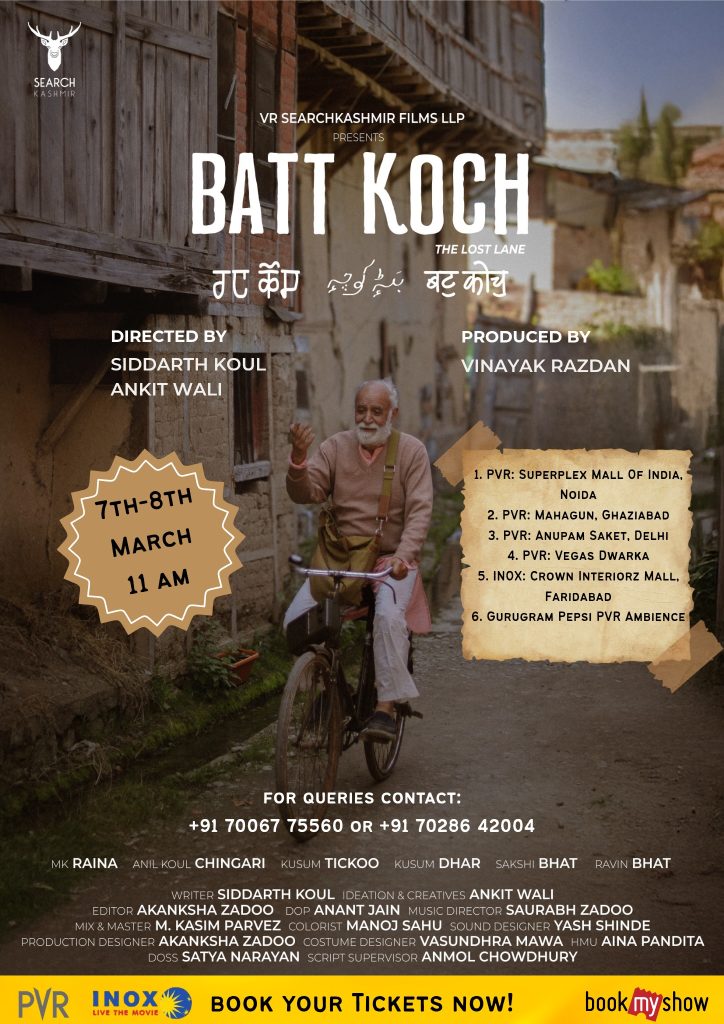
From Jammu Housefulls to a Nationwide Release: Experience ‘Batt Koch’ This Weekend!

Batt Koch movie poster announcing nationwide multi-city screening in Jammu, Delhi NCR, Punjab, and Hyderabad.

It started as a deeply personal story we needed to tell. Today, it has become a shared journey for our entire community.

This weekend marks a massive milestone for Batt Koch and for independent Kashmiri cinema. After witnessing an overwhelming response and packed theatres, we are taking the film to multiple cities across India, allowing families to watch our story unfold on the big screen together.

The Jammu Phenomenon: By Public Demand

The love we received during our initial screenings in Jammu has been nothing short of magical. Seeing the raw emotion, the tears, and the resounding applause from a housefull audience validated everything our team at VR SearchKashmir Films worked so hard for.

Because the demand has been so high, and so many people missed out on the earlier sold-out shows, Batt Koch is still running in Jammu this weekend:

  • Venue: Indira Theatre, Canal Road, Jammu
  • Date: Sunday, March 8th
  • Time: 3:30 PM

A Nationwide Wave: Delhi NCR, Punjab, & Hyderabad Join In

Jammu started the wave, but the rest of the country is catching up fast! For the first time, Batt Koch will be screening simultaneously across multiple major cities, in multiple PVRs.

We are thrilled to announce that this weekend, halls are already filling up fast in:

  • Punjab (Zirakpur) * Hyderabad * Delhi NCR (Noida, Gurgaon, Faridabad, Saket, Dwarka)

A special shoutout to Zirakpur, Hyderabad, and Noida—the community in these cities is taking the lead, and tickets are selling out rapidly!

More Than Just a Movie

Batt Koch is more than just a cinematic experience; it is a bridge to our roots. It is a chance for the older generation to revisit their memories and for the younger generation to see their story brought to life in their language.

We want to see the halls turn into community gatherings. Bring your parents, your grandparents, and your children.

How to Book Your Tickets

Don’t wait until the last minute, as seats are limited and filling up quickly across all locations.

🎟️ Tickets for Delhi-NCR

https://in.bookmyshow.com/movies/national-capital-region-ncr/batt-koch/ET00489940

🎟️ Tickets for Jammu are exclusively available on the Distrct App (by Zomato). 👉

https://www.district.in/events/batt-koch-kashmiri-film-screening-feb4-2026-buy-tickets?

To our patrons in Jammu: We also have a limited flash offer running for ₹199 tickets, as well as a few sponsored tickets for those in need. Please reach out to us on our social media channels for details.

Thank you for believing in independent cinema and for championing our stories. We will see you at the movies this weekend!

-0-

Next weekend we will be trying for more cities.

And in April Batt Koch will reach US shore via Avanti Foundation

https://www.eventbrite.com/e/us-premiere-of-movie-batt-koch-tickets-1983746004701

-0-

Kashmiri Song from the Movie

Awtar Kaul: A Shooting Star from Kashmir Who Pioneered Indian New Wave Cinema”

3–5 minutes

A personal look at Awtar Kaul’s life and legacy, this guest post is by his nephew, Vinod Kaul, a writer and former Executive Director of Rajya Sabha TV.

Early Life in Kashmir and Journey to Filmmaking

Awtar Kaul was born on September 27, 1939, in Srinagar’s Fatehkadal to the Daftari family with no connections to film or theatre. He was one of six siblings. Awtar Kaul’s early childhood was a haven of love and warmth, spent in the nurturing environment of his Matamaal in Safakadal. Kaul’s early education took place at National High School in Srinagar and later in Delhi. Before moving to the United States in 1960, he worked in British Information Services, New York, after completing a Bachelor’s degree in Film from City University of New York. Upon returning to India, Kaul joined Merchant Ivory Productions as an Assistant Director for “Bombay Talkie.”

A very young Awtar Kaul (front row, extreme left, wearing a black coat) with siblings in his Maatamal at Safa Kadal, Srinagar, where he was raised by his grandparents. 1940s.
Awtar Kaul’s maternal grandparents, Vidya Dhar (Gaash Bab) and Raajrani (Taat), who raised him at their home in Safakadal, Srinagar.
Awtar Krishan Kaul as a young man.
In Title credit of Bombay Talkie (1970)

’27 Down’: A Cinematic Masterpiece

Shooting of 27 Down

‘27 Down’ was Awtar Kaul’s directorial debut and unfortunately his only film. Upon its completion in 1974, it was tremendously received and secured two prestigious National Film Awards 1974 – ‘Best Feature Film in Hindi’ and ‘Best Cinematography’. The film has made a lasting impact on Indian cinema and has received international acclaim for the treatment and depiction of emotions of urban alienation. It garnered two international distinguished awards in 1974: The Ecumenical Prize at the Locarno Film Festival and the Film Dukaten Award at IFFMH Munich, Germany, solidifying its position as a masterpiece of Indian cinema. Awtar Krishna Kaul was at the forefront of the New Wave Indian Cinema. This was the time of Shyam Benegal’s Ankur and MS Sathyu’s Garam Hawa. In 70’s, the FFC (now NFDC) helped Mrinal Sen produce Bhuvan Shome, Basu Chatterjee with Sara Aakash, Mani Kaul with Uski Roti and Awtar Kaul with 27 Down. 27 Down was a marked departure from the mould of mainstream Indian films. It was deliberately shot in black and white to create contrasts and shadows alluding to the ups and downs of life. Even after 50 years, this film remains ageless in its treatment, having not resorted to melodrama.

M.K. Raina and Rakhee in “27 Down”

Enduring Legacy and Global Recognition

27 Down has continued to captivate audiences worldwide. In 2013, under the theme of ‘100 years of Indian cinema’, 27 Down was screened at the Festival des 3 Continents, France. To mark the film’s 50th year, 27 Down was screened specially at IFFI Goa 2024. Another recent premiere at ‘The Festival of Singular Films’ on September 23, 2024, at GES-2, Moscow, as part of ‘The Retrospective Program, celebrated the film’s enduring heritage’. In October of 2024, in Barbican in UK, under the banner of ‘Rewriting the Rules: Pioneering Indian Cinema after 1970’, curated by Dr Omar Ahmed, 27 Down was screened as an exemplary film. These accolades have solidified its position as a masterpiece of Indian cinema.

Entry in Sight and Sound Magazine for Locarna film festival of 1974. The film was titled “27 Down Bombay – Varanasi Express”

A Tragic Loss and Unfinished Dreams

Tragically, Kaul’s life was cut short in a fatal accident in Bombay at just 35 years old, ironically on the same day his National Awards were announced. He never got to witness the accolades his film received, leaving behind a poignant legacy in the world of cinema. His brief career, however, is a testament to original and outstanding work in films. He came from a humble family that had no connections to film or theatre and he built his lens and work on his own. Despite having been dealt societal roles and responsibilities, he dared to continue to pursue big dreams. Film 27 Down explores urban alienation, something no Hindi film had done before. Awtar Kaul’s passing has created an unbridgeable chasm, leaving Indian Cinema to ponder the what-ifs of his unfinished works.

-0-

Born in a valley untouched by railways, Awtar Kaul ironically or not so ironically crafted one of Indian cinema’s finest films, ’27 Down,’ using the very essence of trains to weave a human tale.

Kuto Bhayam/Where is fear?

Psychill music mix on an explanation by Swami Laxman Joo on Abhinavgupta’s idea of fear based on Utpaladeva’s Utpalastotrāvalī .

video link to music

Audio: Lakshman Joo, in an old audio recording (circa 1971) explaining “The Paramarthasara”, 105 verses written by the tenth-century Kashmiri scholar and sage, Abhinavagupta, to John Hughes. Hughes transcribed it in “Sri Lakshman Joo-My Notes – Essence of The Supreme Reality.

Fear, is dealt in stanze 58.

Abhinavgupta:

Ekako’hamiti saṁsṛtau janastrāsasāhasarasena khidyate|

Ekako’hamiti ko’paro’sti me itthamasmi gatabhīrvyavasthitaḥ||

(The expression) ‘I (aham) (am) alone (ekakaḥ… iti)’ (is said by) a person (janaḥ) who is distressed (khidyate) by the feeling (rasena) of cruelty (sāhasa) (and) terror (trāsa) in (this) Saṁsāra –Transmigration replete with misery– (saṁsṛtau). (But Abhinavagupta says) ‘I (aham) (am) alone (ekakaḥ… iti)’ (because) who (kaḥ) else (aparaḥ) is existing (asti) besides myself (me)? In this way (ittham), I am (asmi) one who remains (vyavasthitaḥ) free from fear (gata-bhīḥ… iti)”.

Music and Cover art: Vinayak Razdan/SearchKashmir.

In captions, I have added shlokas and translation using excellent web resource : sanskrit-trikashaivism.com

Somehow, Laxman Joo laughing like a child in this audio and explaining the fear, the rational and irrational fears, reminds me of Kashmir winters and in darkness listening fearfully tales of Yakshas and demons and the comfort of knowing none of it is real, there are no demons, you are home, with family, among those who love you.

Enjoy!

“Batt Koch” Kashmiri Film Trailer

Announcing SearchKashmir production: “Batt Koch”, a Kashmiri film.

The full film will be out after March and doing rounds of various film festivals. Will keep you all posted on screening dates.

Batt Koch, a film on Kashmiri Pandits, trailer link

“A place name. A wish. A wish for belonging. Through letters and memories, the film explores the enduring connection to a homeland that remains in the heart. Between lost houses and found connections, expect a few detours and a dose of Kashmiri whimsy. A film by the people who remember.”

PRIMARY CAST:
MK RAINA, KUSUM DHAR, ANIL KOUL CHINGARI, KUSUM TICKOO, SAKSHI BHAT, RAVIN BHAT

SECONDARY CAST:
DELIP PANDITA, ASHRAF FAYAZ, GULZAR DAR, MEHWISH LONE, UZAIR ITOO, VASHISHT MATTOO, SUDANSHU KOUL

PRODUCED BY:
VINAYAK RAZDAN

WRITER:
SIDDARTH KOUL

IDEATION AND CREATIVES:
ANKIT WALI

DOP:
ANANT JAIN

EDITOR:
AKANKSHA ZADOO

SCRIPT SUPERVISOR:
ANMOL CHOWDHURY

DIRECTOR OF SYNC SOUND:
SATYA NARAYAN

COSTUME DESIGNER:
VASHUNDHRA MAWA

PRODUCTION DESIGNER:
AKANKSHA ZADOO

MUSIC:
SAURABH ZADOO

ADDITIONAL MUSIC ARRANGEMENTS:
SARANG AHUJA

MIX MASTERED:
MANOJ SIKKA

RABAB ARTIST:
ABDUL RASHID SHAH

SARANGI ARTIST:
GOWHAR YASEEN

SOUND DESIGNER:
SATYA NARAYAN, JEETU

DI COLORIST:
ANMOL KACHROO

STILLS:
ANMOL KACHRO0

SUBTITLES:
ANMOL CHOWDHURY

HAIR AND MAKEUP:
AINA PANDITA

ASSISTANT HAIR STYLIST:
SHALANI CHAND

1ST ASSISTANT CAMERAMAN:
ANMOL KACHROO, VASHISHT MATTOO

CAMERA TEAM:
ROHIT, SUKHVEER SINGH, JASS

BOOM MAN:
MANOJ JANE

LIGHT TEAM:
GAJENDRA SIKARWAR,RAM CHAWAN, PANKAJ CHOURASIA, SONU

PRODUCTION TEAM:
PIYUSH WALI, AYUSHMAN KOUL, NEERAJ CHANDRA, AADESH GOSWAMI

ON SET ELECTRICIANS:
BALMESH, SAHIL SHARMA

SPOT TEAM:
PURNIMA, PAWAN, MAHESH

Paertho Gilaas By Rahul Wanchoo

A SearchKashmir production. 18th in the series.

“Dimyo Dilas Paertho Gilaas Kulni Tal”

video link

Singer : Rahul Wanchoo

Lyrics : Folk

Music : San J Saini

Female Lead : Surbhi Koul

Screenplay & Written By Umer Nazir, Rahul Wanchoo , Rishab Raino

Line Producer : Rishab Raino , Ayaz Rather

Line production : DivineSpark Productions

D.O.P. : Umer Nazir

Asst D.O.P : Shakir Bhat

Editor : Mudasir Adil

DI : Fahat Firdous

Venue Partner : Mascot Housboat – Nigeen Lake

Special Thanks : Vishal Ganjoo | Parvez

Listen to the audio on all streaming platforms

Shakar Sahib, A saint of Kashmir by Sona Bakaya Moza

Guestpost

The author of this piece on Shakar Saheb aka Shakar Shah Padshah [approx. 1794 to 1830] is Late Sona Bakaya Moza, daughter of Shri Nand Lal Bakaya and wife of Shri Amar Nath Moza]. Sona Bakaya was a direct descendent of Sat Ram Bakaya [elder brother and guardian of Shakar Sahib who had no children].

Sona Bakaya Moza had written the piece in Hindi (original manuscript included in PDF) recollecting the family lore told by paternal grandmother. The work has been translated by Mr. Anil Bakaya.

Aum Shakar Sahibaya Namah

I heard this story on Shakar Sahib from my father’s mother, Veshmal Bakaya. Veshmal Bakaya was the wife of Shri Narayan joo Bakaya. I wrote the same story 60 years ago in Bhajans.

Now I am writing this from the perspective of the Bakaya khandan (family).

Shri Keshav Ram Pandit was the father of Shakar Saheb. At that time, Keshav Ram Pandit was the collector of Kamraj division. In those days, Pathans were the rulers. Shri Keshav Ram Pandit was a rich man, owning lot of land, property etc. People were jealous of him. His wife’s family lived on the banks of the river which also passed the house of the Bhans.

The pathans were cruel to Keshav Ram Pandit and he was stoned to death by the pathans in front of the eyes of his wife’s family. The descendents of Keshav Ram Pandit believed there was a famine in Kashmir during which Kehav Ram Pandit showed kindness to the farmers by not forcing them to pay taxes. The Pathans were furious because they didn’t get the taxes.

Later a bridge was built at that spot and the bridge was named Kani Kadal. A stone is called Kani in Kashmiri.

After Keshav Ram Pandit’s untimely death an outstanding amount was declared as debt owed by him. Bakaya is a term used to describe debt.

Because of this reason the family was called Bakaya family. Bakaya continued to be the last name of direct descendents of Keshav Ram Pandit.

The elder son of Keshav Ram Bakaya was Sat Ram Bakaya. The second son was Himmat Sahib. Govind Ram Bakaya was the third son. The youngest son was Shakar Sahib Bakaya. Shakar Sahib was only one year old when his father was killed.

The elder brother of Shakar Sahib, Sat Ram Bakaya was married to someone in the family of Birbal Kaul who was famous for his senior role as adviser and Minister of the Mughal emperor Akbar.

Maharaja Ranjit Singhji had given him a very good position.

He also got good properties with that position. He spent lot of the money on dharmarth.

His other brother Govindram Bakaya could not cope with the trauma resulting from his father’s terrible death by stoning. Haunted by the memory of that traumatic event, he left Kashmir with his wife and moved to Lahore.  Later we were told he eventually moved to Allahabad .

Sat Ram Bakaya and family continued to live in the Kani Kadal house.

Shri Shakar Sahib also stayed with his elder brother, because Sat Ram Bakaya did not have any children.

Govind Ram’s wife went with her children to Sathoo Barbarshah. When Shakar Sahib was 5 or 6 he started going to school. There he got a takhti and pen.

Shakar Sahib used to take his takhti and pen to school and on the takhti he used to write only RAM RAM on the takhti repeatedly. He had no interest in studies and was immersed in RAM.

One day on his way back from school, Shakar Sahib bought a kabab and roti from a Muslim shopkeeper.

In those days there were lot of differences between Hindus and Muslims. Hindus who saw him eat the food prepared by a Muslim, resented this act.

They went to his mother asking her to expel Shakar Sahib from their house. The poor mother was very sad and asked him: Why did you do this? You brought so much anguish to our society. They won’t let you stay here.

Seeing his anguished mother, he took her to the riverbank next to their house. He took out his intestines and washed them. The kabab and roti were still intact as if no one had chewed them. Every person watching this miracle was amazed. It was so unbelievable that someone could take out consumed food by emptying his stomach.

He asked all the spectators “Am I purified now or not?” The astonished spectators were dumbfounded and left the place silently.

Shakar Sahib’s mother also forgave him and allowed him to stay in their house.

This way he was engrossed in his bhajans.

His elder brother Sat Ram Bakaya owned lot of properties. He bought land in Rambagh and when asked what the purpose was for buying the land, Sat Ram Bakaya said it should be made my samadhi after I die. My brother Shakar Sahib is a “mastana”, what will he do?

At that very moment Shakar Saheb gave him a vardaan [a promise/blessing] that he will be blessed with a daughter. Her offspring will continue the family clan for generations going forward.

After some time he was, indeed blessed with a daughter. Our Bakaya family are direct descendants of Sat Ram Bakaya’s daughter. 

In those days Kripa Ram was a very wealthy person. He was a disciple of Shakar Sahib. Whenever he would pass by the river in front of Shakar Sahib’s house, he would visit Shakar Sahib. His boat had ghungroo made of silver and pedals for the boat were also made from silver. These would make a specific sound because of which Krima Ram was nicknamed Krip shrone [shrone means a particular sound made by a pedal pushing the water].

When Sat Ram Bakaya’s daughter was born, Kripa Ram gifted them two bracelets/bangles made of gold and a dussa shawl.

Kripa Ram had lot of faith in Shakar Sahib. But on one occasion he passed by and forgot to greet Shakar Sahib with a Namaskar. On this occasion his boat got stuck and was unable to move forward. Then he realized his mistake.

He started praying. He used a rope made of grass to anchor his boat to the house. He walked up to pay obeisense to Shakar Sahib. From that day whoever would pass by the bridge in front of the house would chant “Shakar Shah Padshah” before moving forward. 

As the years went by Shakar Sahib got more and more respect from disciples. His disciples included reputed families in Safa Kadal and every day after making food they would take a thali to him for bhog. One day someone made the meal jootha [impure], and when the thali was sent to Shakar Sahib two men dressed in black clothes came and said Our Shakar Shah padshah said Our Shakar Sahib does not eat this impure food. Take it back.

The same day when they returned a member of their household who held a good position in was punished by black water in accordance with orders from Raja Ranjit Singh’s darbar. 

Then he went to Mahan nand joo’s house who was a very wealthy individual. He came barefoot to Shakar Sahib and begged him for forgiveness. Shakar Sahib then comforted him and asked him not to be fearful; it was a mistake. When he was back at Maha Nand  joo’s place he found his order was withdrawn.

One of the maids of Shakar Sahib’s mother was a Muslim but he would treat every one similarly without discrimination. One day that maid said she also does Shakar Sahib’s work and asked for his blessing. Shakar sahib asked her to tell him what was her wish. The maid said she wished for her family to eat from a thali [tram] made of gold. Shakar Sahib said: Tathastoo [So be it!]. Upto now people from that village Bachgam, are more wealthy.   

Shakar sahib’s mother forced him to get married when he was only 10 years old.  In those days Dila Ram was a very wealthy person. Shakar Sahib’s marriage was arranged with Dila Ram’s daughter. 

When she was 13 she had her “gauna” after which she moved to Shakar Sahib’s house.

But whenever she would enter Shakar Sahib’s room she could not see him and could see only snakes and scorpions. For a few days she slept outside Shakar Sahib’s room. But after a few days she told her father about this experience. But her father had lot of respect for Shakar Sahib. Her father had a good chat with her and asked her to continue to stay in the house of Shakar Sahib. Sadly, she died when she was only 18.

Dila Ram did not terminate his relations with Shakar Sahib. He treated Shakar Sahib with lot of respect. He would still visit his son-in-law and take gifts to Shakar Sahib on his birthdays. The gifts would be typically a pheran made from pashmina, a dussa shawl and a pot of yoghurt/curds. When the father-in-law left, Shakar Sahib would distribute among his disciples, the birthday gifts received by him.

In Kashmir there was a village called Batgund where one of his disciples named Shankar would hold prayers for Shakar Sahib. One day Shankar’s family members came to see Shakar Saheb to give him the sad news of the passing away of Shankar. But Shakar Sahib did not believe them. He accompanied them to their village. On arrival Shakar Sahib sat next to the corpse; Shakar Sahib then lifted his cap from his head and placed it on the head of the corpse. At once, Shankar came back to life and sat up. On seeing this miracle all the people watching the miracle were stunned to see a dead man getting his life back. Since that time on that day people of that village perform a yagya/havan on the anniversary of Shakar Sahib’s birth as well as death.

Hindus as well as Muslims accepted Shakar Sahib’s extraordinary powers and Shakar Sahib was given a special title in recognition of his powers. A popular poem was composed In Kashyap’s Kashmir produced many saints but the highest level was attained by Shakar Sahib.

Several objects belonging to Shakar Sahib were preserved as relics: his sandals, his pillow, his cap, his hookah and a scroll (book) on which RAM RAM was written by him hundreds of thousands of times. It is not known where his Takhti is. But it is said touching his relics brought about quick healing to the sick. We observed his sandals were used by our family to bring to an abrupt halt natural  calamities like fire and flood. Pointing the sandal towards the advancing fire or flood would stop it from creating further damage. 

Shakar Sahib’s other brother who used to live in Sathoo preserved Shakar Sahib’s sandals and charpoy, [bed]. Shakar Sahib’s cap was preserved  in Batgund village.

After some decades Sat Ram Bakaya’s daughter got married to a Kotru boy from Rainawari. Sat Ram Bakaya was rich and gave away sandals made of gold and silver as dowry.

This  led to jealousy among people and they made verses to taunt the display of wealth selection was made from gold and diamonds. 

Sat Ram Bakaya’s daughter gave birth to a son and daughter. The son was adopted by Sat Ram Bakaya. He was named Tota Ram Bakaya. Tota Ram got married to a girl from Kaul family in Alikadal. They had 3 sons. Shri Narayanjoo, Shri Man joo and Shri Damodar joo Bakaya. Narayan Bakaya got married at the age of 9 to the only daughter of Amar Chand Khosa. The marriage ceremony took place in Nageen Bagh. A few years later there was an earthquake occurred repatedly. Every person was evacuated from their houses. People had to live in boats because their houses had fallen because of the earthquake. All their belongings and documents. Information on the year of occupation in the house. In their house a cupboard was saved from damage. Tota Ram Bakaya’s daughter was young when she was widowed. It is not known if the earthquake occurred before or after Tota Ram’s death.  

Narayan joo Bakaya’s maternal uncle used to live with them. One day he dropped a cup of food and he had marks all over his body. The marks looked as if some one had beaten him. The marks were seen as punishment from Shakar Sahib.

In about the late 1930s / early 1940s Maharaja Hari Singh’s brother-in law used to comefor home tuitions to the Bakaya family. His home tutor was late Shri Nand Lal Bakaya [also father of the author Sona Bakaya/Moza], son of Shri Narayan Joo Bakaya who was also a Master at Mission School.

The brother-in-law’s name was Omkar Singh. He used to spend a lot of time in the home of Shri Nand Lal Bakaya. One day Omkar Singh said he will go to Shakar Saheb’s prayer room in the Bakaya house. As soon as he entered the room, he got scared and thought Shakar Sahib was chasing him. Out of fear he ran away from the prayer room.

Footnotes

1. The author’s husband Amar Nath Moza did a good service to India in 1947. He happened to be in Baramulla when the Kabalis raided Kashmir. He was one of the first people to escape from Baramulla in 1947 and rushed to the Bakaya home in Kani Kadal, Srinagar. On arrival in Kani Kadal he asked his brother-in law Shri Prem Nath Bakaya to communicate news of the Kabali aggression to the right people in Delhi. Shri Prem Nath Bakaya took him to the nearest telephone at the fire station. The telephone was monitored by Pakistan informers. They called PNB’s contact, DayaNand Kachru who was Nehru’s Secretary. Daya Nand Kachru’s wife picked the phone, her husband was in the office with Nehru and his cabinet. Shri Amar Nath Moza cleverly uttered the following words “Shotur chav Varmul munz.” When Nehru came to know about the aggression, he immediately flew Indian troops to Srinagar.

2. The relics of Shakar Sahib are currently in two places Shakar Sahib’s pillow and Khadaon [footwear] are in the Jammu house of Shri Vijay Bakaya, IAS.

Anil Bakaya

-0-

The article has been uploaded to archive.org with permission of Mr. Anil Bakaya, as part of SearchKashmir.org Free book Project

The article can be accessed here: archive.org link

Saint Shakar Sahib by P.N.Bakaya

Guestpost

History of saint Shakar Saheb aka Shakar Shah Padshah [approx. 1794 to 1830] active during the Sikh rule era of Kashmir based on family lore of Bakayas. 

The author of this piece on Shakar Saheb is Late Shri Prem Nath Bakaya, IAS son of Shri Jia Lal Bakaya]. Shri Prem Nath Bakaya was a direct descendent of Sat Ram Bakaya [elder brother and guardian of Shakar Sahib who had no children]. With permission of Mr. Anil Bakaya, uploaded by SearchKashmir.org Free book Project

Our family’s eminent spiritual legend, Shakar Sahib In our joint family we, even as children, were encouraged to have faith in some widely acknowledged saints. It started with an ancestor of our Bakaya family called Shakar Sahib. We were told about him as part of the Bakaya family folklore. He had been popular for his spiritual powers and some noteworthy events. In fact there were many stories of his miracles. The family maintained some of his relics in a pooja (worship) room in our Kanikadal home on the bank of the Kutakul stream which had branched out from the river Jehlum. 

 One of the stories was about an arrogant governor who ruled over Kashmir as representative of Maharaja Ranjit Singh (Maharaja of the Sikh empire 1780 to 1839). It was said that the governor took frequent tours in the city of Srinagar as a part of his inspections. He used a large boat driven by twelve sturdy rowers. He liked the sound of their rhythmic rowing; he was known by Kashmiris as Kripa – Shruni (Lover of the sound produced in perfect unison while his boat was rowed). It was said he was going in that boat, one day over the Kutakul stream. His boat could not proceed beyond the point at Kanikadal, where Shakar Sahib lived. He urged his team of rowers to proceed. They did their best but the boat did not move. He was enraged; he started scolding them. But one of the boatmen who knew of Shakar Sahib dared to stand up to suggest that they should land and pay respects to the saint. It was a practice for passersby on the boats to say “Shakar Shah Padshah” (meaning Shakar Sahib is king). The arrogant governor felt there was no option, he agreed and was taken to visit the saint. He greeted him. Shakar Sahib spoke, “It is good you came; there is a bad news, people feel you are a good ruler but a complaint has been made to the king in Lahore, you are being called and a different governor is being sent to Kashmir. You should go, explain your position. The king will be convinced and you will come again. Have faith in God almighty. Do not be arrogant, you can go.” The governor was taken aback. He became pensive. He went back to his boat which started moving. It was said this prophesy came true after about a month. He was summoned to Lahore to be reprimanded by the King – Maharaja Ranjit Singh. He was able to explain his conduct. The king asked him to wait for his decision as his dismissal was possible. After a few days he was summoned again and told the complaint was found untrue and he would be sent to Kashmir again. But he was directed to be humble while governing with strength and strictness. After I grew up I read in a history book that one governor Kriparam was the king’s representative who was in Kashmir in 1819 was recalled on some complaint but cleared and deputed for a second term. The history book did not mention about the Saint’s warning and prophecy but this was part of our family folklore which was full of many other stories of Shakar Sahib’s miracles. It was said that as a child he was precocious. He mixed freely with all boys of his age – both Kashmiri Hindus and Muslims. Once his Muslim friends bought a cooked mutton mince delicacy (harsa) from a street shop. He felt ‘tempted’ to taste this too. His Hindu companions complained to his mother that he had outraged his religion. His mother was sad, called him over and reprimanded him sharply and said he had despoiled himself and started crying. He was upset and pleaded with his mother that there was nothing to worry as all the boys were brothers there was no difference between Hindus and Muslims but she was disturbed. He assured her that he would cleanse his stomach. So he was reported to drink glasses of water which he excreted after an hour or two it contained the stuff that was said to have cleared out and off. It was said that to reassure his mother of his purity, he vomited out his intestines into the river, washed the intestines with the river water and swallowed back his intestines. Shakar Sahib’s parents forced his marriage to a young pretty daughter of a wealthy Kashmiri Brahmin, Dilaram Mandal. He resisted but was overruled and the girl joined the family as a favorite daughter-in-law. The story goes on when the girl was pushed into his room for the first night, she felt that Shakar Sahib was in deep meditation and was surrounded by a circle of very bright light. She felt endangered and could not stay on. She cried and ran out. She told her mother-in-law who was amazed, but consoled her and asked her to not be afraid but should try again next day. She could not summon the courage but she helped her mother-in-law to serve Shakar Sahib. But when she entered his room she thought she saw a snake surrounding him. She reported her experience to her own parents and her motherin-law, who also saw a snake. Her father felt it was a mistake but was convinced that her daughter may be destined to be a serving disciple of a budding saint. He used to visit Shakar Sahib on his birthdays and present him a nice Pashmina Shawl (a warm soft wool wrap) every such day and wrap it over him. It is said, Shakar Sahib, by this time had accepted a Muslim disciple. This gentleman would take over the shawl and keep it safe in his possession while Shakar Sahib looked quietly on unconcerned. When on the third or fourth anniversary the wealthy father-in-law (Mr. Dilaram Mandal) put yet another shawl around Shakar Sahib’s body, he offered his respects and left. The Muslim disciple started removing the expensive nice wrap. Shakar Sahib stopped him and said – “No, you have received back all the value of the amount I owed you as a repayable debt in my earlier birth, now onwards this will be given over to someone else deserving it.” The message in this episode is there is a limit in every relationship imposed by karma on what you owe and what needs to be repaid. Shakar Sahib’s guru was Mirza Kak Sahib and we often visited Kak Sahib’s Samadhi, the place where he was cremated on the banks of a beautiful stream a few kilometers from Kokernag on the way to Anantnag/Srinagar. In the Bakaya family we lived with these delicious but inspiring stories and always remembered the heritage of an inspiring spirituality. While we were growing, we were encouraged to join our elders’ visits to the third storey small room used as the family’s prayer room. The room was small but enriched with precious Souvenirs of our family saint, revered Shakar Sahib. A part of the headgear turban he had worn, a small notebook packed by a tiny sized writing of ‘RAMA- RAMA’ in Hindi letters, a little stick usable as a help to lean on while holding a prayer book and a worn out pair of wooden clogging which Shakar Sahib used for walking outdoors. We enjoyed the rhyme and rhythm of the hymns either Sanskrit or Hindi or even Kashmiri that the elders recited with devotion. We could remember some of the easier ones but we were attentive while the recitation was going on. The Puja – worship and prayers was a daily routine – led either by my Dad or uncle Nandlal or uncle Jejkak. This time period of half an hour to 45 minutes was very quiet and elevating. This routine daily exercise created a curiosity in me and my cousin sister Sona three to four years elder to me and we talked it over and decided to find details about Shakar Sahib. So one day the two of us approached the eldest living member of the family, NandLal’s mother Vishimaal. She told us she had not seen Shakar Sahib in person but heard many legends about him and his spiritual prowess. She said that Srinagar, at that time had a number of saints, many of them used to visit Shakar Sahib to pay respect to him. She had heard that one saint, Labi Shah who lived mostly at Tulamul (Khir Bhawani) shrine used to tell everyone “Kashapani Kashiri Mastana Setiha, Shakar Sahib chhu Sahibi Dasgah” which means, in Kashmir there are a number of Saints, Shakar Sahib has lot of power. This made Shakar Sahib known and many people visited him to pray for his favors. A Muslim lady from the neighborhood used to visit Shakar Sahib, to help serve him she told him she was very poor, she had no house of her own. Shakar Sahib asked her to walk with him in the neighborhood. He took her and they walked over around an area then he suddenly stopped and told her she would own this piece of land and have a house of her own. She felt this seemed impossible and asked him “How could this be? The land belongs to a rich man and I have no money to buy” The saint smiled and told her this was what “God willed”. After a few days the owner of the piece of land, who had lost his wife about a year ago, sent a message to this lady whether she would agree to marry him. She was aware that she was a poor woman, while he was quite rich. She felt this was not possible but the man repeated the offer. They married and constructed a house on that plot of land and he gifted this house to her while they lived there as husband and wife. Veshmal told us that she had heard of some stories of miracles performed by Shakar Sahib. She said the saint was approached by his neighbors to save them from an epidemic of cholera which had appeared and caused lot of panic, as a result of some deaths. He told them he would pray to God and asked them to walk with him from his house in Kani Kadal to Sathu, while he continued to pray in silence. It was found that the entire area was saved. No case of cholera occurred in that large area. In another instance, a relative of Bakayas living at a short distance was frightened when a house near his caught fire and had started moving in the direction of his house because of the strong wind. He ran to our house and took a holy relic, a Takhiti, a flat piece of wood on which the Saint had written “RAMA RAMA” and held it against the wind. He said that the fire changed direction and his house was saved. Veshmaal’s Dad said he was a personal witness to this miracle, while the saint was not personally living. I came to see an article written by someone whose name was not written there. Actually the K P Journal “Koshur Samachar” issued one or two issues exclusively covering stories about the many Saints and spiritually advanced Gurus (Teachers) who were very popular in Kashmir over a period and some who were living. I could not get access to the issue of that main journal which mentioned Shakar Sahib but the one printed journal I received seemed an auxiliary journal called the “Khir Bhawani Times” the issue was dated Jammu 1998.  The article in this journal was purported to be written by one member of the Bakaya family. He has mentioned some instances of miraculous powers of Shakar Sahib related to him by a cousin, one Mr. Radhakrishan Bakaya. These seem to be stories of unbelievable character, but the world of saints and savants is believed to be extraordinary. For instance it says Shakar Sahib’s mother was scared when she saw him cross over the flowing kutakul with his wooden clogging in his feet or when he would climb a standing wooden pole. He is stated to invite other Saints and savants and entertain them, provide food on certain occasions and sometimes tea. Usually he remained silent and absorbed in meditation, feeling comfortable in their company. One story recites an occasion where Mr. Dilaram and his family took Shakar Sahib to Khir Bhawani – something happened and he felt upset and just walked away. They tried to stop him but he started running and did not stop. After some days he was found to have reached village Khrew, quite a distance, where another saint, Jeevan Sahib, resided with his disciples. The saint was expecting another saint to come over and asked his disciples to prepare to receive him. He arrived and saint Jeevan Sahib embraced him. His disciples asked who he was as they saw their Guru very excited and overjoyed meeting him. Saint Jeevan Sahib told them that in their previous birth both of them were co-disciples of a great Guru and he (Jeevan Sahib) was the elder one, and the time came for him to give up his body, he prayed to his Guru that in their next birth both of them should be born in places near each other so they could continue to meet and advance their spiritual career together. He told them that the great Guru had obliged and now he was expecting him to meet Shakar Sahib. After few days the story goes Shakar Sahib was told by Saint Jeevan Sahib that Shakar Sahib’s wife was very ill and nearing her death. He told him he should go and see her at Srinagar. Shakar Sahib reached Srinagar and went to the cremation ground where his father and brother Hemant had brought the dead body. He told his brother to perform the funeral rites treating her as his mother. His brother agreed and Shakar Sahib stayed on till the rites and the cremation ended. Then he went to stay in the Kanikadal house. After sometime he is said to have gone to a village Batagund near Sopore where he had two of his disciples one Shankar Lal and another Hyder Ali. He saw Hyder lying unconscious taken for dead but he called him, then he put his own cap on his head. Hyder woke and stood up to pay his regards. Shakar Sahib is said to have given up his body when he was just 36 years old. As I have said already, we in the Bakaya home used to attend the daily puja performed every morning by our elders. I recall that we felt very peaceful and happy. Whenever anyone in the family faced any problem, he or she visited the room and meditated, focusing on his memory and the holy relics. Doing this made them forget their worries and could feel the tension dissipate. My wife Parma lost both her parents when she was in her 20’s and used to cry for them for several years. She felt a presence of Shakar Sahib as a young boy consoling her. We used to pray to him for success in exams and other important occasions including marriages in order to receive his blessings.

-0-

The article has been uploaded to archive.org with permission of Mr. Anil Bakaya, as part of SearchKashmir.org Free book Project

The article can be accessed here: archive.org link